Below is a log of my brief, happy life as a Seafarer:
June
11—I am aboard the Julius S, in a
relatively spacious, though spartanly-motel, fourth-deck, corner cabin, about
the size of my mieszkanie on
Karmeliczka, though, sadly, without a microwave or a tea kettle. It does have a
refrigerator, however, with a resident Beck’s, and a cold one. More to my
deserts than the Crowne Plaza Hotel Antwerp at 180 euro a night—I didn’t pay
full price, nobody ever does—this berth will bear me home in basic comfort and
excellent company. After two days in Antwerp, and fifty plus years everywhere
else, I conclude that luxury is indeed more luxurious than basic comfort, two
or three times more, but you pay four or five times more for it in terms of
money, with an additional sales tax in life and soul, unless you are very lucky
or sufficiently ruthless.
Around
me on the dock, rows and rows of containers, heavy industrial modes of moving
them, big-wheeled caddies, barges, cranes, with squat cylinders of fuel oil,
cooling tanks, chimneys, windmills, and, of course, expanses of gray harbor. An
operative industrial aesthetic that we don’t get to see too often in the heart
of the heart of the country, largely, crudely rich in capital—stuff—and men in
coveralls and hardhats. The old commercial capitalism. God love it.
After a
solitary and unexceptional curry in the galley, I, the only passenger on this
short haul to Liverpool, found myself in the officer’s bar drinking beers with
the captain and an international cast of officers—German, Russian, Slovakian,
Bulgarian, Romanian, and a largely Philippine crew—who were chain-smoking
hand-rolled cigarettes to a man (note to self: remember pipe), reminiscing
about their wilder days in African, Asian, and South American ports, and happy
as clams to be making the summer milk run between Europe and America. The
captain bears a remarkable, though Wagnerian, resemblance to my brother Neil,
and he sports a fair knowledge of and appreciation for the oeuvre of Pink Floyd and the Grateful Dead. Could you ask for a
more capable crew?
I’ll
sleep well tonight.
 |
| Supercargo Cabin |
 |
| Bunk |
 |
| Antwerp Dock |
 |
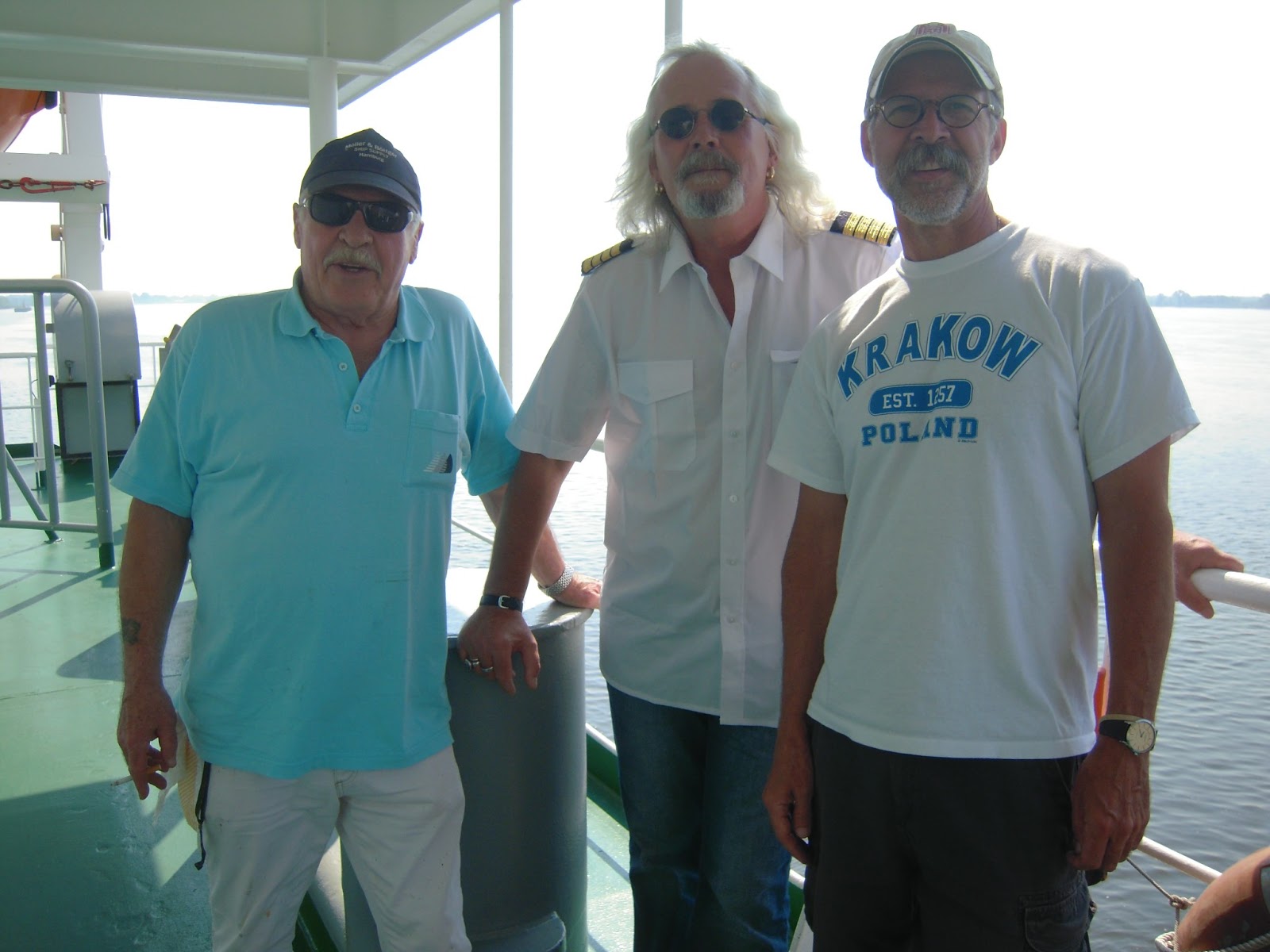
| Captain, My Captain |
 |
| Antwerp Harbor Lights |
Homeward
Bound: June 12—In my very first week in Kraków, I discovered a bar just down
the street, on Studencka, the Stary Port, the “Old Port,” which I had
thought at one time to make a sort of base of operations. But not having
actually been at sea—except metaphorically—I thought myself, though
sufficiently old, absolutely unqualified. To haunt there would be too much of
an affectation. I did attend once with Dr. Banaś, where I questioned the extent
and authenticity of Polish sea-faring, citing Davies: “Despite modern
propaganda, which pays great attention to supposed maritime traditions,
Poland’s connections with the Baltic were extremely slender…. and have only
marginal significance.” In all of my reading, I have not run across the name of
a Polish navigator/explorer, pirate, commercial ship’s captain, company, or
admiral. A 16th century poet once asked “What cares the Pole about
the ocean’s stand?” (53-6), which I take as the ultimate authority,
notwithstanding Dr. Banaś’s protests. The bar offered live music, sea shanties,
to which she confessed that she was not partial. Need we say more? For
sea-faring we must turn to ex-pats, to Józef
Teodor Konrad Korzienowski, Joseph Conrad.
Underway
at 11:15 a.m. Six hours down the river to the English Channel. How long it
would have taken my grandfather to pass the Schelde, I do not know, but with
the aid of atmospherics, I have begun to consider his journey, his podróż. How different does an estuary
look a hundred years later? The gray water, the wide wet sandy flats, the green
rushes, the dairy cattle grazing on the firmer plots, some sheep, sea birds.
But as the “Supercargo,” I review it all from a lofty elevation; he, no doubt,
stowed below deck, probably even below the waterline. The Schelde would have
looked differently from there, and smelled so. I don’t pretend to enact, or
even re-enact, but only to rehearse in as humble a fashion as reasonable.
June
13—The seas today are flinty gray with hints of aquamarine in the wake, and
rougher, so that not only do I feel the constant, low thunder of the engine,
but now, too, some gentle heaving. The cook asked me yesterday if I got
seasick. “We’ll find out,” I replied. So far, the worst is as turbulence on a
jet flight, a little shake, a little shimmy, a light lurch, and a constant
rattle. We’re heading into the wind,
when we turn the corner on Great Britain, the captain expects the going to get
smoother.
The
evolutions of a broad expanse of water, the roil, the boil into foam and the
surprising whip of spray, the ceaseless rolling out of fractal equations,
hypnotizes me like a camp fire or the movement of clouds before a storm,
producing a somber, majestic lethargy.
At noon,
the sea is heavier, a dark green obsidian under the sun, the wind strong and
cold. We pitch and drop, and my stomach begins to unsettle, the intimations of
nausea. It seems to help to look off into the distance, to the horizon, or to
lie in bed with your eyes closed; the fewer planes of visual attention, the
better. I’m reminded of the upside-down house in Szymbark—which wasn’t even
moving—and how visual disorientation leads to vertigo and unbalance. A couple
of weeks of this, or a month or more, which my grandfather might have endured,
would evacuate a man pretty completely of his past.
A few
hours, and the worst of the chop is over. Whatever else this passage becomes,
it does not promise a Caribbean cruise.
June
14—A smooth beginning to the day, breakfast with the captain, a most agreeable
German bon vivant, a calm Channel and
mild winds. I finished Conrad’s Secret
Agent yesterday, a melancholy and miserable story of secret police and turn
of the century anarchist counter-terrorism gone awry. Nothing about Poles or
the sea. I could read “Some Reflections on the Loss of the Titanic” for its 101st anniversary. Maybe after we
depart Liverpool.
We
arrived in Liverpool right on time, entered the lock, then threaded the needle
of a passage to our slip assignment at 2:00 p.m., where some unloading and
loading proceeded. While Liverpool is a smaller port than Antwerp, I had much
more time to observe what strikes me as just the staggering scale of industrial
commerce: big boats, many big boats, cranes and loading gantries 300 feet high
(“much bigger ones in Chinese ports”), two or three different types of
container caddies, themselves 75 feet high, and thousands of containers moving
into a small port from all over the world in a single day. A massive operation
of technology, engineering, and capital. A small-town boy and a small,
landlocked provincial-city mind, I have my doubts whether humanistically
inclined revolutionists could run this machine, much less understand it.
 |
| Coming Into Liverpool |
 |
| Liverpool Crane |
 |
| Liverpool Dock and Container Caddy |
For our
brief port call, two officers, Chris and Julius, and four or five more crew,
and one passenger, myself, taxied into the Cavern Quarter, named for the bar in
which the Beatles launched themselves, now a tourist Mecca, in which alcohol
was, is, and will be served, now and forever. I participated in a 3-pint
Guinness “poob crawl,” beginning at a Pizza Hut, where we laid our foundation,
then hoofed over to the Cavern, for pictures and souvenirs—my dear Mayor, my
dear Musician, you will be pleased—and beer. The Cavern and the Lennon are two
dark holes in the ground, painted black, and house a few acoustic relics and
memorabilia of the New Evangelists, including a live musician from the era,
pencil-thin, almost skeletal, playing some pretty respectable blues with
undying reverence. A sinner, I neglected to thank him for the vision of true
faith before we left for The Grapes and the Reminiss, lesser sites on the
pilgrimage, the latter, throbbing techno on a sticky floor. A good brief time
in a good place, though not the kind of stop a Polish immigrant would have made
in 1902. One can’t repeat the past, but one can try to make it rhyme, tap one’s
foot to the backbeat.
 |
| Club Entrance |
 |
John & Josh
|
 |
| Bluesman |
June
15—A sunny sky and a relatively calm morning on the Atlantic. A couple of young
Swiss women, M & M, one a lawyer, the other an artist, boarded in Liverpool
for the long haul to Chester/Philadelphia. Together we received a safety lesson
and a tour of the engine room, which again impressed me with the mass and
complexity of modern economic and industrial systems. An engine, 4 decks high,
a straight-7 cylinder, each cylinder assembly about the size of a shower stall,
turning a shaft about 1 meter in diameter, at the end of which is a propeller 7
meters across. Twenty thousand horsepower. The ship requires and generates the
power necessary for a small city, burning 400 tons of fuel for one trip across
the Atlantic at $600 a ton. It carries enough fuel oil and diesel to reach
America and back, and then some. And the Julius
S isn’t nearly the largest of ocean-going vessels. And we’re one of
thousands. International, transcontinental trade in stuff, things, material
requires big boats to move. Most of us still live material lives, blithely
ignorant of where and how things are made and how they get to us; we know only
a little, our own corner, of how the world works, if that. I don’t think anyone
does know how it all works, but it seems to. Better for a few than for the
many; satisfactorily, perhaps, for a majority than not; miserably, no doubt,
for too many. But how to make better, systematically, what we don’t understand.
I couldn’t even pass the safety exam that ended our tour.
 |
| Chief Mechanic & Fellow Passengers |
 |
Straight Seven
|
 |
| Control Room |
June
16—We are now miles out to sea, no land in sight, and we will be this way for
days, until the coast of Newfoundland and Nova Scotia. All about, the Atlantic
is more or less uniform in its motion, a rearward undulation, the rise and fall
of its breath slow, its color a few shades of gray with aquatints aft as the
propeller churns air and bubble into the mixture. It melts back into gray under
the sun in the distance, which trims a sliver of the horizon in platinum. This
is the image of the void, the
formless waters above which the spirit of God moved na porczątku.
 |
| Na Porczatku |
 |
| Let There Be Light |
We
gained another hour last night, which we’ll do every two days, and must
remember to “retard” our clocks to synchronize. The captain says we will not
likely see another vessel until we’re near port. What must be the loneliness of
things out here, of God, of gull, and the rare single-handed sailor.
June
17—Reading during the long watches, a history of the Jews in Poland, a
biography in Polish of the warrior hetman Stefan Czarniecki, a little Conrad, a
little Herbert, a bit of Miłosz: “Indeed, the ocean shows us what we really
are/Children who for a moment feign the wisdom of captains.” (174) And Pinker,
too, on the decreasing violence of our species under the influence of
civilization, a fortunate and not unreasonable captivity. A long way to go, of
course, and with no certainty of reaching the angelic kingdom on earth, but if
we happened to reach that oft-promised land, would we be human beings anymore?
Or truly angels? And one of the socio-economic vehicles of this transformation,
trade—“the container ship.” (284)
Gray
today, grays, many, light and dark, a lively chiaroscuro, though my camera
can’t capture it. The brightnesses are lost, and thus, the sharpness of the
contrasts. Abaft, the horizon is befogged. The sea is rough, the wind strong,
the boat shakes as it rolls steadily ahead. Through no will nor conscious
effort of my own, I do not blanch as I did earlier. “You get used to it,” they
say. I guess you must.
We seem
to have stalled momentarily out here on the high seas, at about 4:30 p.m.
As it
turns out, we weren’t stalled. We were rescuing a boat, a single-handed sailor
adrift in the North Atlantic, now a very fortunate single-handed sailor, safely
aboard, but his boat—and to hear him speak of it, his heart and soul and no
small part of his life—alas, remains adrift, now long away and out of sight.
D__ is a
Portuguese, from the Azores, a good, sweet, sympathetic fellow, who concedes to
being obsessed about work and about his boat—and maybe, too, about
adventure—having bought the shell in 2005 and spent these last eight years
sailing and refining, sailing and improving, sailing and customizing, sailing
and perfecting his tight little craft for his longest adventure to date, a
navigation to Iceland, begun just over a week ago. Named for the moon, Lua was sailing beautifully until last
night, when in heavy seas, her rudder snapped, leaving him in a perfectly
watertight vessel with engine, masts, and sails intact, but no way to direct
his efforts. Alerted to the situation at midday, we made a sharp turn north and
picked him off his boat at 4:30 p.m.; the captain and crew of the Julius S do good work. But we are not
equipped (nor empowered) to tow a small vessel thousands of miles to safe
haven. Uninsured for such a loss, D__ says with a misty eye but a resigned and
philosophic voice, “This is life,” which is to say, “life is hours and hours of
lovely, ingenious work (and many euros) lost.” When it is only that…
 |
| Lua Adrift |
June
18—Spent an hour with my captain on the bridge, a quiet, lofty, high-tech space
well appointed with ashtrays and binoculars. So automated is the sailing of
this vessel, there is often only one person on the bridge at a time keeping but
half an eye on the various screens. It could serve as well for the study of a
philosopher or a Zen meditation hall. The captain showed me his weather and
course-plotting software and pointed out the iceberg line and the general
resting place of the Titanic. We’ll
be in the vicinity over the weekend. In the meantime, laundry.


We’ve
been eating very satisfactorily onboard, three squares a day possible, and
while this routine offers more than I am accustomed to eating, I have from time
to time eaten this third meal—the first of the day actually. It’s called
“breakfast.” Interesting concept. A couple of days ago, the cook prepared for
the midday meal chicken cordon bleu,
and while I cannot claim it exquisite, it was pretty good for freighter fare on
the high seas. Which reminds me that I have a reckoning to correct.
Among
the many failures I have to report on this trip is my failure to eat the duck. Kaczka Krakowska, “wild duck Cracow
style,” I had (almost) every intention of eating, and I had the time on Friday
night before I left, but I simply did not have the appetite, having devoured
the previous week or so golonka; kotlety
szabowy, kurkurowy, cielęcinowy; kremówka, karpatka; naleśniki; zapienkanki,
kebab and the Polish version of Asian stir-fried noodles. (Pork
knuckle/joint stewed in beer then roasted, courtesy of the Golonkarnia, that is, the “Golonka House”; pan-fried cutlets of
batter-dipped pork, chicken, and veal; cream cake and chocolate cream cake;
“pancakes,” though they’re rather like crepes or, when filled, quasi
enchiladic; baked open-face melted cheese sandwiches—Slavic gut bombs—and the
fast fusion foods from the mid and far easts.) Absent the duck and kiszka, I have eaten traditionally
enough now to significantly upgrade my estimate of Polish foodways. While I
cannot accord it the bluest ribbon, I know I could eat there as happily (and as
unhealthily) as I do in the United States.
On the
subject of bread and cakes, ciastki,
I’ve not eaten better, and know of no place where you can find a freshly-baked
loaf of all these varieties, and more, across the street: galicyski (“Galician”),zbojnicki
(“bandit/pirate”), chłopski (“peasant”),
góralski (“highland”), sadecki, królewski (“royal”), słoneczniki (“sun-flower seed”), cyganski (“gypsy”), żytny (“rye”), krakowski (“Cracow”), włoski (“Italian”), pasterski (“pastoral”), wiejski (“country”), kresowy (“frontier”), okrągły (“round”), ziomek (“compatriot”), ludwik
bawarski (“Bavarian”), tygryski
(“tiger”), słowianski (“Slavic”), pełne ziarno (“whole grain”), finski (“Finnish”), turecki (“Turkish”), rodzinny
(“family”), and pszenny (“wheat”).
The variable staff of life in Poland. With szarlotka
as the crown.
June
19—We are steaming through a couple of low pressure systems, which means
inclement weather, rain, wind, chill, chop, hours for reading and writing.
Yesterday the captain and the bosun saw whales to starboard, dramatically
flukes up. He thinks we will see more. The day before, we were visited by
porpoises, dark ones with flat, curious faces, sporting off to port. A brief
inter-species gathering. Otherwise, we lumber on alone into mist and gray.
A week
now on the water, sometimes, briefly, under the sun and the largest possible
dome of sky—mostly cloudy—with the most efficient horizon, the widest vista
available, and the longest northern days upcoming, I am not bored, though I
have begun to anticipate returning to my old life, not a new man by any means,
or wishing to become one, like my grandfather, nor even a significantly changed
man, but not the same one either, just myself at the end of a sojourn, a
discrete, bounded, and singular experience. Ocean watermarked, I could visit
now the Stary Port in all honesty.
June
20—Into a serious fog. Or is that just a fogged window? Both, it turns out.
More rough dark sea, an almost wintry scene, late winter, when the snow is dark
from dirt and exhaust with only random spatterings of white. Summer means
different things in different places.
Longest
Day: June 21—And not only because we add an hour tonight at midnight. After a
rough patch of ocean, reading up on the social history of violence, the Jewish
experience in Poland, Czarniecki at the battle of Chocim, the tough-minded
poetry of Herbert, and watching two hours of The Hatfields and the McCoys on the recommendation of my captain,
the skies have cleared, the waters have smoothed, with summer impending. While
Pinker effectively argues that the world moves steadily in the direction of
universal lows in global violence, we all live our lives individually, locally,
where squalls of lethal inhumanity and misfortune are our world, imbed themselves in our subjective consciousness and
memory. Not least in the press. Fortunately we get little news out here of the
world—some, but not much, a brief compendium of a half dozen stories, and more
sports, once a day—and no news of our family and friends, which I trust is good
news.
We only
passed within 300 miles of the final resting place of the Titanic. The weather has taken us farther north than the collision
site, though still much farther south than the current iceberg line. We plunge
again into fog as we cross into the warm moist air of the Gulf Stream.
Clear of
the fog we find dolphins, slowly arching on the dark surface or sporting in the bow wake, and enjoy our
first sunset. Of my sights to see, only whales and stars remain. Day ends,
summer has begun.
 |
| Solstice Sunset |
 |
| Solstice Sunset II |
 |
| Atlantic Twilight Colors |
Message
in a Bottle: June 22—Emailed the Mayor of my expected arrival, Tuesday morning,
the 25th. (It’s an old email address. See if he gets it.) If all
goes as expected, I will be through customs by 10 a.m. In the hands of my
friends and brothers, home.
As I
finish Herbert, he dismisses the notion of voluntary émigrés, and I have to
take his point to heart,
Emigration
as a form of existence an odd thing
pitching
your tent without friends and family
living
without sanction duties we all will agree
our
homeland weighs heavily on our shoulders (497)
Or lightly, which is not bad,
when you are getting older. But the poet seems to get cranky in his 70s,
crankier, not undeservedly, but gentler, too, wistful even, with old friends. I
have to read him, however, at his toughest-minded.
June 23—Saw whales yesterday from
the bridge, though by “seeing whales” I only mean glimpsing a few spumes and
the smallest dorsal patch of whale, that largest of living creatures on earth,
the dark matter of the seas. On the menu last night, duck, not Cracow style,
but not bad. Afterward, we retired to the bar for Saturday night beers, then
over to the crew lounge for karaoke. I scored in the low 90s for “Bad Moon Rising”
and “Bridge Over Troubled Waters,” A-.
The waters are smooth today, you
can’t believe it’s the same Atlantic. Not so smooth as a mirror, but rippled
like stained glass, blue under the sun with diamond highlights, gray ahead
thereof. I learn that the Mayor did not receive my message.
Our first clear night. Tea on the
bridge with the Filipino officers. A fine moonrise over the Atlantic, Wschód księżyca nad Atlantykiem, with
fishing boats aft on the horizon. These precise scapes and shades I will likely
never see again. Vast as they seem, they are nothing compared to the vastnesses
that they are, now completely black and light.
 |
| Moonrise over the Atlantic |
June 24—My grandfather crossed
the Atlantic from Europe to the U.S. three times: once as a young man with a
dream, once as a grown man with a plan, and finally as a man with plan and
dream thwarted. Sometimes God blesses us with failure. I’ve read enough Polish
history and poetry now not to envy the lot of heroes or imagine the fate of my
father, my aunts and uncles under the Nazis or the Soviets. So that, if I’ve
not made as much progress as I had hoped—two small steps, not some great leap
forward—I calculate that the odds on a qualified failure are at least a
qualified future, that is to say, a future, a tomorrow, back in the land of
opportunity.
June 25--Farewell to the Julius S, the crew and my traveling companions.
 |
| Julius S |
 |
| Passengers |
 |
| Old Men of the Sea |